
Cisco ONS Transponder Replacement: Compatibility and Migration Checklist
A Cisco ONS transponder cannot be replaced safely from a part-number fragment or optical reach alone. The replacement decision must preserve the shelf and card context, supported software release, client-side interface, line-side wavelength plan, optical budget, management behavior and service-protection design. Build an evidence package before requesting a quote or scheduling a maintenance window.
Identify the exact installed platform
"Cisco ONS" covers several generations and configurations. Record the complete shelf designation, chassis variant, controller and software release. Then capture the installed card name, product identifier, hardware revision, slot and service configuration.
Do not assume that two cards with similar names are interchangeable. Official platform documentation can impose slot, controller, release and feature dependencies. A compatible optical component also does not make an unsupported card combination valid.
Collect:
- Shelf and chassis model.
- Controller and software release.
- Card product identifier and hardware revision.
- Slot and protection relationship.
- Provisioned service type and rate.
- Current alarms and performance history.
- Existing client- and line-side optics.
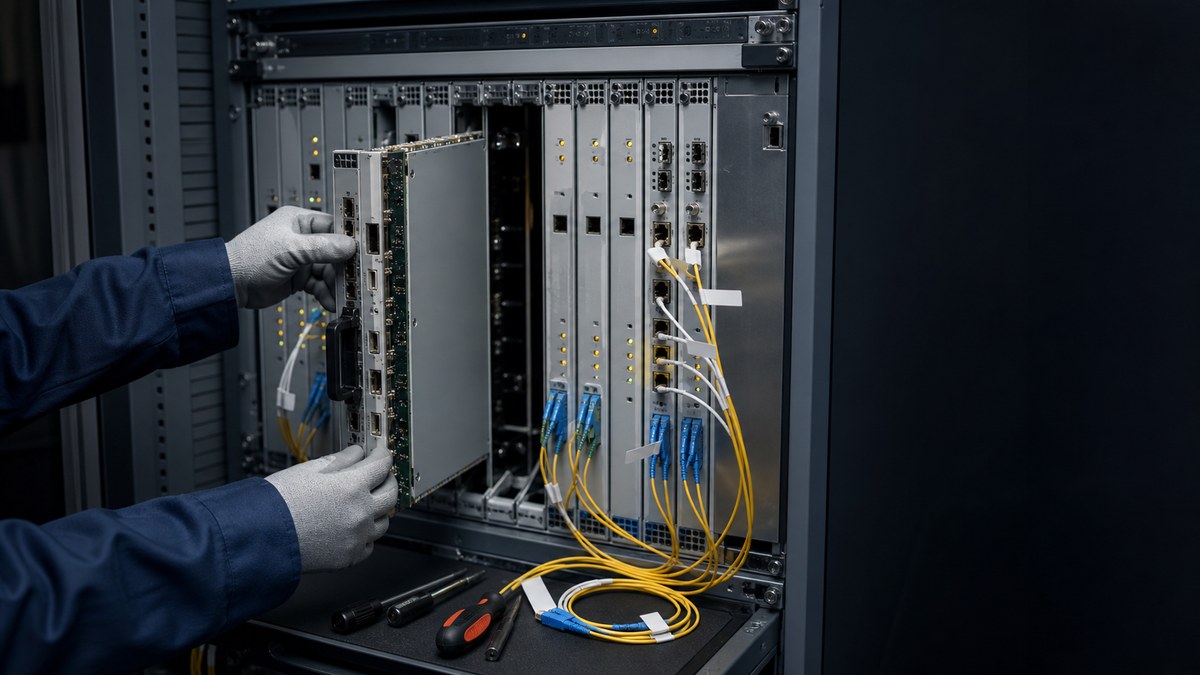
Photographs can help identify labels and connectors, but the live inventory and configuration should remain the primary evidence.
Separate the client side from the line side
A transponder converts or maps a client signal to a line-side optical signal. These two interfaces may use different form factors, wavelengths and operational constraints.
For the client side, record the service rate, framing or protocol, connector, fiber type, reach and the equipment at the remote end. For the line side, record the exact wavelength or tunable range, grid, modulation or card mode, launch power, receiver limits and passive or amplified optical path.
Do not describe a replacement only as "10G 1550 nm". That phrase does not establish the channel, application, reach, power levels or management behavior. If the card uses a tunable line interface, capture the provisioned frequency or wavelength and tuning rules.
Verify software, slot and management support
Use the official Cisco ONS documentation for the exact release and platform. Confirm that the target card or optic is supported in the intended slot, by the installed controller and software, and for the provisioned service.
Also verify how the platform identifies and manages the component. Required checks may include inventory recognition, alarm reporting, performance monitoring, wavelength provisioning and digital diagnostics. A module that produces light is not necessarily manageable or operationally supported.
Keep the replacement scope narrow. Do not combine an optic change with an unplanned controller, software or card migration unless the dependencies require it and the change plan covers the additional risk.
Rebuild the optical budget from the actual route
Calculate the line budget using the exact transmitting and receiving interfaces. Include fiber attenuation, connectors, splices, patch panels, multiplexers, filters, attenuators, amplifiers and an appropriate engineering margin.
Check both minimum and maximum received power. A short route or amplified path can overload a receiver even when the maximum reach appears sufficient. In a dense wavelength-division multiplexing system, also confirm the channel plan, passband and any optical signal-to-noise or dispersion constraints required by the platform design.
Compare the calculated values with current measured power and historical baselines. An unexplained difference may indicate route changes, dirty connectors, amplifier drift or a documentation error that should be resolved before replacement.
Define the compatibility evidence package
A supplier should not be asked to infer the target from a partial label. Provide a controlled request containing:
- Exact platform, shelf, card and software release.
- Client-side service, form factor, connector, fiber and remote endpoint.
- Line-side wavelength or channel, reach and optical-path details.
- Required coding, identification and diagnostic behavior.
- Operating-temperature and environmental requirements.
- Quantity, spare strategy and required validation evidence.
If an alternate component is proposed, require a written mapping showing what is equivalent and what remains to be validated. Avoid claims of universal ONS compatibility.
Stage the replacement outside the live service
When equipment and operational policy permit, validate a sample in the exact or representative shelf, card, release and configuration. Confirm recognition, provisioning, alarms, diagnostics and traffic behavior.
Record the original state before replacement. The maintenance method should define fiber labeling, electrostatic-discharge controls, cleaning and inspection, the order of operations, acceptance checks and rollback criteria.
After insertion, verify:
- Expected inventory and no unexpected equipment alarm.
- Correct client and line configuration.
- Transmit and receive optical levels at the applicable interfaces.
- Stable service and required performance counters.
- Protection switching or redundancy behavior when in scope.
- Monitoring and alarm visibility from the network-management system.
If the replacement is detected but the service remains down, preserve the evidence and follow a layered isolation process. The SFP detected but link down guide is useful for separating recognition, configuration and optical-path issues.
Protect rollback and future support
Retain the removed working component as a controlled spare when appropriate. Label it with the platform, service, date and reason for removal. Save configuration backups, inventory outputs, optical readings and test results.
For an aging platform, the immediate replacement should support a broader lifecycle plan. Track supported software, controller and card dependencies, available spares, repair options, lead time and the intended migration destination. A substitute that restores one circuit but cannot be managed consistently may create a larger operational problem.
Frequently asked questions
Can I order an ONS replacement from the card label alone?
Usually not safely. The shelf, controller, release, slot, client interface, line wavelength and service configuration can all affect the correct replacement.
Is the same data rate enough to prove compatibility?
No. Data rate is only one condition. Interface type, wavelength plan, optical levels, framing, management and platform support must also match.
Can a tunable transponder replace any fixed wavelength?
Only when the exact platform, card, release, grid, tuning range, optical specifications and management behavior support the intended channel. Do not assume universal substitution.
Should the existing optical power be recorded before the change?
Yes. Record both directions and relevant intermediate points. The baseline helps distinguish a replacement problem from a pre-existing path issue.
What should be tested after replacement?
Verify inventory, configuration, alarms, optical levels, service traffic, performance counters, monitoring visibility and protection behavior required by the service design.
How many spare transponders should be held?
Base the decision on installed population, failure impact, repair and lead time, platform age and the migration schedule. There is no reliable universal percentage.
Send the complete ONS service context
Share the shelf, controller, release, card and slot, client interface, line wavelength, route design, optical readings, required diagnostics, quantities and maintenance schedule. Axonode can help organize a traceable optics or transponder sourcing request and coordinate validation with vetted OEM manufacturing and testing partners.
Contact Axonode for legacy optical-platform sourcing support. Related resources include the optical transceiver portfolio and the OEM versus compatible optics procurement guide.
 Cisco ONS Transponder Replacement: Compatibility and Migration Checklist
 Pluggable Optics Installation and Commissioning Checklist